
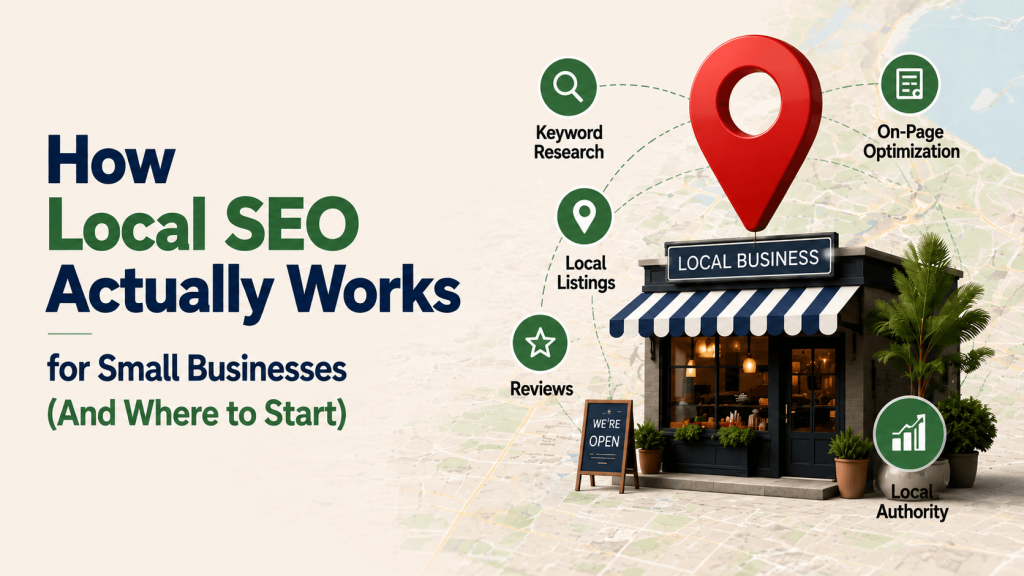
A bakery owner in Ohio once told me she had no idea why a competitor two blocks away kept showing up first when customers searched for cupcakes nearby, even though her shop had better reviews. The answer had nothing to do with luck. It came down to a handful of unglamorous, consistent habits around how her business information appeared online.
Local SEO is not a mystery reserved for big-budget marketing teams. It is the practice of making sure search engines, and increasingly AI tools like ChatGPT Search and Google AI Overviews, understand exactly who you are, where you operate, and what you offer, so they can confidently recommend you to nearby customers.
What Local SEO Really Means
At its core, local SEO is about matching your business to the intent behind a search. Someone typing ‘plumber near me’ or asking a voice assistant ‘who fixes water heaters in Dayton’ wants a fast, trustworthy answer. Search engines pull from many signals to answer that question: your website, your Google Business Profile, and the directories and citation sources that mention your business consistently across the web.
This is where experience matters more than theory. In practice, businesses that treat their online presence as a network of connected, accurate touchpoints tend to build trust faster than those relying on a website alone.
The Role of Consistent Information Across the Web
Search engines and AI answer tools cross-reference your business name, address, and phone number across many sources before deciding how much to trust a listing. If your address is written one way on your website and differently on a directory, that inconsistency creates friction. It does not necessarily break anything overnight, but over time it chips away at the confidence algorithms place in your data.
This is also true for how AI search tools generate answers. When a chatbot summarizes ‘the best HVAC company near me,’ it is often pulling from structured, repeated mentions of a business across trusted sources rather than a single webpage.
Building a Foundation with Business Listings
A solid local SEO foundation usually starts with claiming and completing your Google Business Profile, then extending that same accurate information to reputable directories. This is where a platform like Pro Business Street fits naturally into the process. Getting listed on Pro Business Street gives your business another consistent, verifiable mention of your name, address, phone number, and services, which supports the kind of citation consistency search engines look for.
Directories also give you something a website alone cannot: independent third-party confirmation that your business exists, operates where you say it does, and serves the customers you claim to serve. That kind of corroboration is part of what builds long-term online trust.
Conclusion
Local SEO is not a single tactic but a collection of small, consistent decisions repeated across your website, your Google Business Profile, and trusted directories. Businesses that treat those pieces as one connected system tend to build the kind of digital presence customers, and increasingly AI search tools, can rely on.